
How to Search Civil Dockets
For a current public civil setting, open the official Docket Search filtered to Archuleta County. Pick the county plus a short date range. From there you can narrow by court, case, party, or attorney. A date-only request gets rejected, so bring at least one filter. The best match comes from a known case number. The form splits the four-digit year, the case class, and the sequence into separate boxes.
What you get back is an event row. It lists the setting date, start time, duration, case number, hearing type, location, and appearance type. Courtroom shows up when that field applies. It will not hand you the complaint, the service return, the answer, motion text, an order, or a judgment sum. Nor does it give you any downloadable case documents. For those, turn to the Clerk of Court, Archuleta Combined Courts.
- Decide whether District Court or County Court has the civil matter.
- Choose Archuleta County, set a narrow date range, and add a required second filter.
- Enter the year, civil class, and sequence in the separate case-number fields when known.
- Match the event by case number, hearing label, place, and courtroom rather than by name alone.
- Request the Register of Action or named filing from the clerk when the event row is not enough.
The County Court event view displays the calendar-centered layout that Archuleta County civil docket results follow.
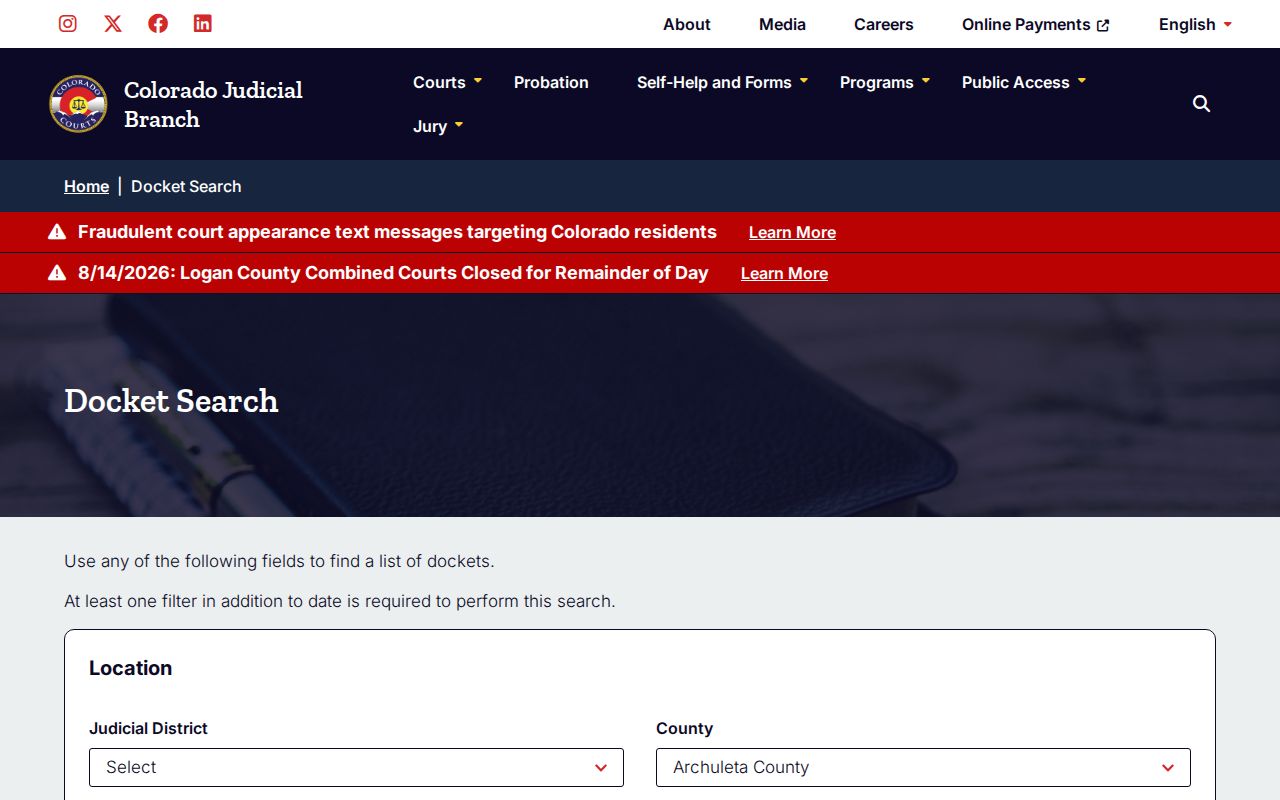
That screen serves hearing research only. The Combined Courts clerk stays the source for civil case history and documents.
Archuleta County Civil Return Dates
A Return Date on Summons is a label. You may see it on the Archuleta civil calendar. It is not an automatic trial date. It marks the deadline or setting tied to responding or appearing after a summons. For your exact duty, read the summons and the newest court order. If the public row and the notice disagree, call the Combined Courts clerk. Do not rely on either one alone. A later pretrial or hearing label sits at a different stage. Keep each notice matched to its civil docket entry.
Archuleta County Civil Docket Class Map
Class letters route an Archuleta County civil docket search to the right court. District civil cases generally carry CV. County civil matters use C. The state request form also lists S for civil or small-claims work. Domestic relations cases run under DR, probate under PR. A class alone is never a unique identifier, since every full number adds a year and a sequence.
| Class | Court track | Typical scope |
|---|---|---|
| CV | District Court | General civil matters above County Court jurisdiction |
| C | County Court | Civil cases within the county limit, including eviction matters |
| S | County Court | Small-claims civil work identified on the records form |
| DR | District Court | Domestic-relations proceedings |
| PR | District Court | Probate matters, subject to document-level limits |
Archuleta County has no Texas-style justice-of-the-peace civil docket. Small claims sit inside County Court as a division. Pagosa Springs Municipal Court is not a general civil forum either; it handles town ordinance and municipal traffic cases.
What a Civil Docket Shows
The civil event system exposes only a compact set of setting fields. The clerk's Register of Action, or ROA, works differently. It is a chronological summary. It can list filings, minute orders, settings, and the case result. Behind that summary sits the complete file: the complaint, return of service, answer, motion, signed order, exhibit, and judgment themselves.
| Case number | Filing year, civil class, and sequence, such as a system-level YYYYCVsequence. |
|---|---|
| Event fields | Date, time, duration, party name, hearing type, Archuleta location, appearance type, and courtroom. |
| ROA fields | Case class, parties, filings, chronological events, minute orders, settings, and judgment or other outcome. |
| Documents | Complaint, answer, motions, proof of service, signed orders, judgment, and other filed material requested separately. |
| Access limits | Protected identifiers, sealed material, and some family or probate documents may be withheld or reviewed. |
Do not mistake the free calendar for the full civil docket sheet. It answers when and where. The ROA answers what happened in sequence. The filed document answers what the pleading or order actually said.
Archuleta County Civil Small Claims Dockets
Small claims belong to Archuleta County Court, not to a separate justice-of-the-peace court. The state record form groups class S with civil matters. Use the County Court track. Confirm the class on the filed papers. The event search may come back silent. Request the ROA. Do not shift the query to Pagosa Springs Municipal Court. The ROA can supply the case sequence. The complaint and judgment remain separate documents available through the clerk process.
Archuleta County Civil Docket $25,000 Line
Colorado draws the line at $25,000. Civil matters under that amount go to County Court. Larger general civil matters go to District Court. That court also takes the domestic-relations and probate classes under the same routing rule. This is a court-routing rule, not a search fee and not a statement about what a claim is worth after judgment. Check the class and court on the summons or latest order before choosing a filter.
Quick answer: Search County Court for civil matters within the $25,000 ceiling and small claims. Search District Court for larger civil claims, domestic relations, and probate.
Eviction and forcible-entry matters are County Court cases in Colorado. No separate JP court handles them. When the docket search returns no row, make sure the selected court matches this division of work before assuming the case is absent.
Types of Civil Cases on the Docket
Archuleta Combined Courts keeps both tracks. One is the general-jurisdiction District Court civil file. The other is the limited-jurisdiction County Court civil file. Public access varies by file and document, but the class signals the broad procedural path.
- District civil disputes above the County Court amount limit
- County civil claims, eviction matters, and small claims
- Domestic-relations proceedings, including permanent-orders settings
- Probate cases and requested probate documents
- Protection-order matters listed within civil request choices
Municipal ordinance cases do not belong on this list. Pagosa Springs Municipal Court is a distinct city court. A town dispute does not become part of an Archuleta County civil docket just because it arose inside the county.
Archuleta County Civil Docket Outcomes
Civil outcomes demand precise terms. A default judgment follows unmet response duties and legal prerequisites. A dismissal may come with or without prejudice, which controls whether the claim can return. A voluntary dismissal comes from the claimant. A satisfaction means an existing judgment has been paid or otherwise satisfied; that is not the same event as entry of judgment. Settlement, agreed order, reopening, and appeal round out the list of outcomes. In any given case, the signed order supplies the exact legal effect.
Archuleta County Civil Docket Timeline
Open an Archuleta County civil ROA at the top. You usually find a complaint or petition plus the entry showing the filing fee paid. A summons comes next. Then comes proof or return of service once the other side has been reached. From there the file may show an answer or response. Silence is not judgment, though. Default only follows once the legal requirements are met. The docket itself never equals an automatic judgment.
Civil docket flow: Complaint or Petition › Summons and Service › Answer › Case Management › Motions › Hearing or Trial › Judgment or Dismissal › Post-Judgment Activity
Mid-file, the docket shifts to scheduling. Case-management, initial, status, and pretrial events fix deadlines and move the dispute toward decision. Motions and responses appear in sequence. Their text lives in separate filings, not on the ROA. A ruling shows up as a minute order or a signed order. The end of a case can take several shapes. Judgment is one. So are agreed order, dismissal, voluntary dismissal, default, or trial judgment. Afterwards, the docket may record satisfaction, enforcement steps, a transcript of judgment, reopening, or an appeal.
Settings and Hearings on Civil Dockets
Archuleta civil and family calendars use a handful of common labels: Return Date on Summons, PreTrial Conference, Status Conference, Initial Conference Appearance, Permanent Orders Hearing, and Hearing. Each one marks a stage. None of them promises a final trial. A return date simply tells a summoned party when to respond or appear, so treat it as the trial date only if the court's notice says so outright.
A reset does not mean the case was dropped. The court authorizes continuances, usually after a motion or request, and the old event can linger in the calendar history while a newer notice controls. Line up the newest signed notice against the latest docket result, and call 970-264-8160 if the two disagree.
For family cases, the Judicial Branch describes the Family Court Facilitator program, including its Sixth Judicial District routing, on the page that follows.
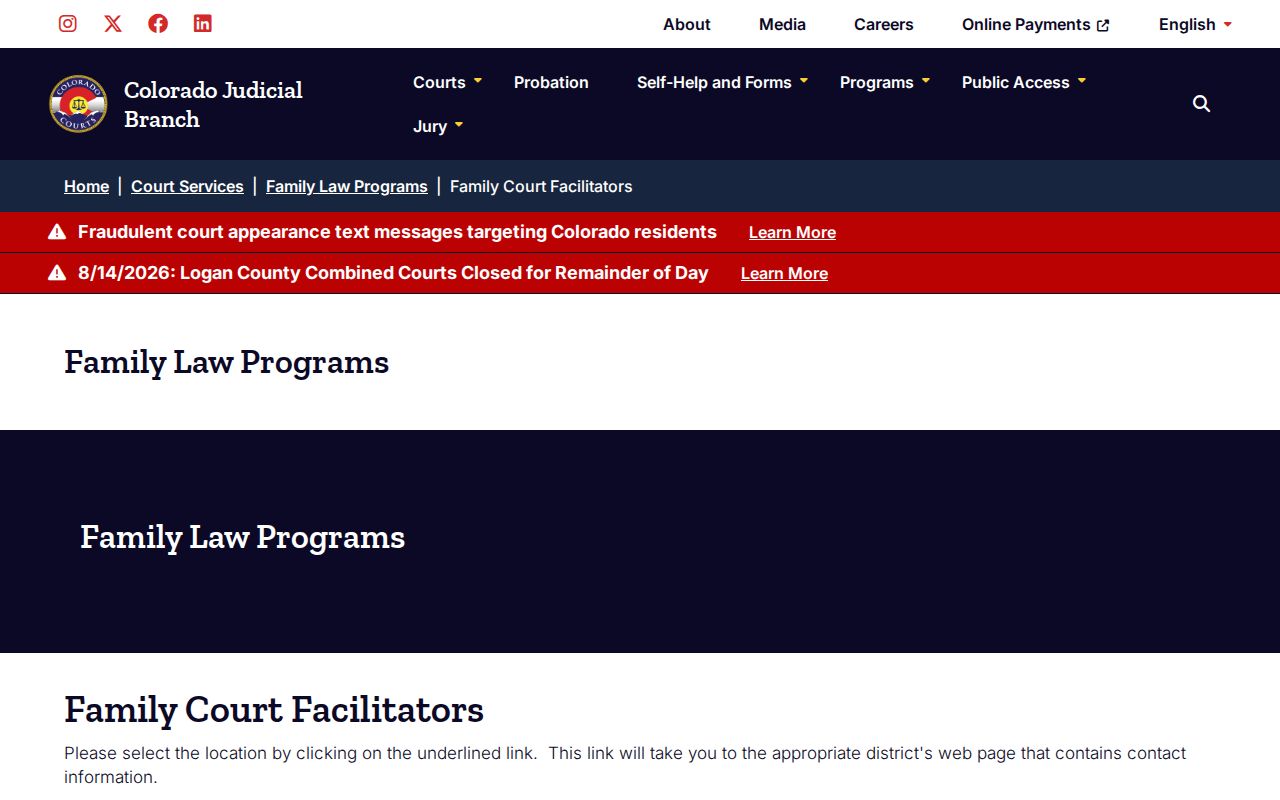
A facilitator can help with procedure and forms. The actual setting still comes from the Archuleta County civil docket and the court's own orders.
Archuleta County Civil Judgment Records
The state request form lists several distinct products. An Order for Judgment, Transcript of Judgment, Satisfaction of Judgment, Protection Order, probate items, and a Register of Action all appear. They are not interchangeable. An order for judgment records the court's ruling. A transcript of judgment is a certified statutory record product. Despite the name, it is not a word-for-word account of courtroom testimony. A satisfaction, in turn, records that the judgment has been paid off.
| Product | Live form amount | Purpose |
|---|---|---|
| Copy | $0.25 per page | Ordinary case-document copy; party and attorney cap is $15 |
| Transcript of Judgment | $25 | Certified statutory judgment product, not hearing testimony |
| Certificate of Satisfaction | $20 | Certification that a judgment has been satisfied |
| Certified or exemplified copy | $20 per document | Added clerk authentication |
| Off-site retrieval | Actual cost | Archive retrieval when the file is stored off site |
Copy costs are modest but layered. A name search runs $5. Research or redaction work is $30 per hour. It is billed in 15-minute parts after the first hour. Starting or responding to a case carries separate charges listed on the Judicial Branch's court filing-fee chart. Those filing fees are not record-copy fees. Confirm the current amount, file location, and payment method with the clerk before ordering. Never mail cash without instructions.
Money owed on an open case goes through the official Colorado court collections and payments route. That service does not replace a clerk document request or the free hearing calendar.
Public Access to Civil Dockets
Public access to Colorado court files runs under Chief Justice Directive 05-01. The free event search is one open door. Yet not every case and document can appear online. Sealed records, protected identifiers, and restricted material may be withheld. Probate is not fully closed. But certain documents or proceedings can demand proof of identity or authority. Family matters can carry protected content too.
Access rule: Chief Justice Directive 05-01 controls access to court records, while Colorado Open Records Act requests generally address administrative government records rather than filed judicial case documents.
A missing civil event can result from the date window, wrong class, wrong court, a restricted matter, or the event-only limits of the public search.
There are three ways in. Request the ROA or documents through the state Record/Document Request Form. You can also visit the Archuleta Combined Courts counter. Or contact the clerk at 970-264-8160 or archuletaclerk@judicial.state.co.us. Ask about terminal access at the courthouse. The clerk publishes no specific local mail, fax, or drop-box rules. So arrange those channels first. The Justice Center sits at 109 Harman Park Drive in Pagosa Springs.
Archuleta County Civil Dockets and E-Filing
Colorado Courts E-Filing, or CCE, is the Judicial Branch's system for filing and service. Authorized case categories include district general civil, domestic, probate, and water cases. County civil, eviction, foreign judgment, name change, protection-order, and replevin matters are also covered. It serves lawyers and parties. It does not serve the public at large. The free Archuleta County civil docket search still stands on its own.
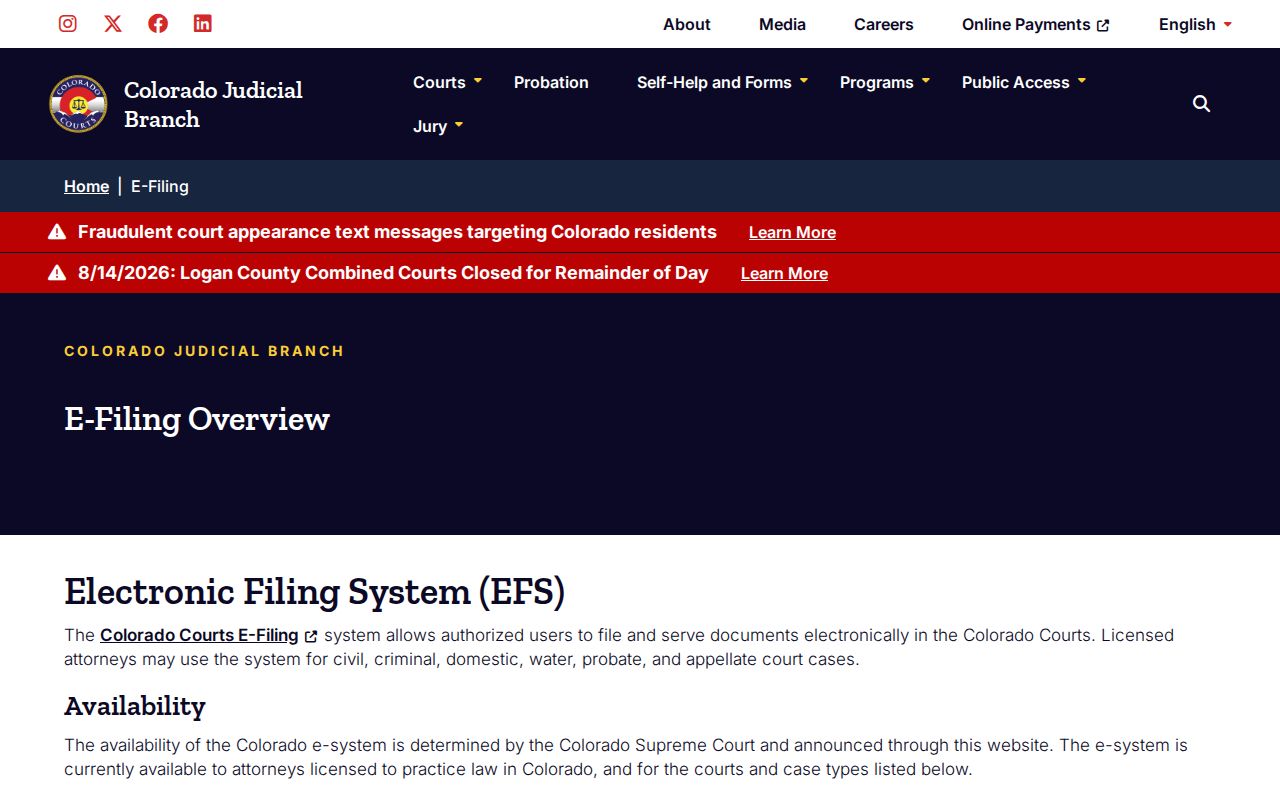
E-filing belongs to a participant workflow. The free public calendar is an event tool. The clerk remains the official records source.
Eligible non-attorneys can opt into their own supported domestic-relations or eviction case. Once the court accepts them, they may reach documents in that one case. Access is tied to the user's case and authorization, not to public browsing. For a public hearing, use Docket Search. For an official ROA, order, judgment, or other filing, go through the clerk process.
Note: filing through CCE does not guarantee a new event. One may not appear at once in the public Archuleta civil calendar.