
How to Search Criminal Dockets
Begin with the free Colorado Judicial Branch Docket Search filtered to Archuleta County. It lists events, not full case histories. Pick Archuleta County and set a short date range. Then add a filter for court, case, party, or attorney. The system demands at least one filter beyond the date. Each result can show time, duration, case number, hearing type, location, appearance type, and courtroom.
The cleanest key is a case number. Colorado numbering splits the filing year, the class, and the sequence. For a felony-class search use YYYYCRsequence; for a misdemeanor-class search use YYYYMsequence. No number in hand? Choose Individual or Business first, then fill in the right name fields. A broad name search can return several rows. One setting may repeat for every listed party.
- Confirm whether the matter is state, county, or municipal before opening a search.
- Choose Archuleta County and the shortest useful date range, then add a required non-date filter.
- For a known number, split the year, class, and sequence into the form's separate fields.
- Compare the case number, hearing label, time, courtroom, and appearance type in the result.
- Ask the Combined Courts clerk for the Register of Action or filed order when the calendar lacks the needed facts.
Archuleta County Criminal Charge Details
The public Archuleta County criminal docket calendar leaves out the charge block. No cited statute appears there either. No offense level appears. A hearing label or a CR class can point your search in the right direction. But it never replaces the charging document. The exact allegation matters? Ask the Combined Courts clerk for the complaint, the information, or another public charging paper. An ROA may summarize the charges. Yet the filed charging paper alone carries their full text and classification.
Archuleta County Criminal Dockets: CR or M
The class code usually reveals the court. Felony prosecutions belong to Archuleta County District Court, part of the Sixth Judicial District, which holds general jurisdiction. Misdemeanors and state traffic matters go to Archuleta County Court, which can also take an early felony complaint or advisement before the case moves up. Both state courts run as Archuleta Combined Courts. One Clerk of Court keeps the files for both.
| Class or source | Likely court | What to expect |
|---|---|---|
| CR | District Court | Felony settings and later felony case stages |
| M | County Court | Misdemeanors and county-level criminal settings |
| JD | District Court | Juvenile delinquency, with access limits |
| Town code | Pagosa Springs Municipal Court | Municipal ordinance and municipal traffic cases |
That split can trip up a docket search. An early felony event may sit under County Court even though later proceedings belong to District Court. A Pagosa Springs ordinance charge stays in Municipal Court unless an appeal or a separate state charge pulls related work into the state system.
What a Criminal Docket Shows
A public Archuleta criminal docket result is just a hearing row. It does not reproduce the charging document. It also omits the bond order, motion text, full case chronology, disposition, and sentence. The clerk's Register of Action, often called the ROA, gives the brief chronological case summary. Filed pleadings and signed orders live separately. Know which layer holds a fact and you avoid a failed case lookup.
| Date and time | The scheduled start of the event, with a displayed duration. |
|---|---|
| Case number | The year, case class, and sequence used to match the matter. |
| Hearing type | A label such as Hearing on Advisement, PreTrial Conference, Status Conference, or Disposition Hearing. |
| Place | Archuleta County, courtroom number, and any displayed appearance type. |
| Not in the row | Charges, statutes, bond terms, judge, filings, disposition, sentence, and document images. |
For charges, request the complaint, the information, or another charging paper. For the outcome, the statewide request form offers a Disposition/Sentence Order and a Register of Action. Choose a certified copy when an office or another court needs formal proof.
Archuleta County Criminal Bond Records
Bond is one more fact the public event row never displays. The terms may sit in the current public order or the ROA. The clerk can tell you the lawful record channel. Never infer bond status from an advisement date, a virtual label, or an old event. Ask for the latest public order and confirm no later court action changed it. A calendar search can find the related hearing. It cannot establish current release terms or replace the court's order.
Finding Archuleta County Criminal Advisements
Archuleta calendar labels have included “Hearing on Advisement.” This is an early setting. The court may address rights, allegations, release, counsel, and the next step. Searchers often check only District Court because the charge is a felony. Yet a felony complaint can receive its first advisement in County Court. That comes before the prosecution proceeds in District Court.
When an expected setting is missing, change one factor at a time. Check County Court along with District Court. Confirm the CR or M class and the exact sequence. Widen the date range but keep the required added filter. Still nothing? Call the Clerk of Court at 970-264-8160. A missing public event can mean the wrong court or a narrow window. It can also mean a protected case, or the natural limits of a calendar search.
The official District Court event view shows how Archuleta County criminal settings are presented.
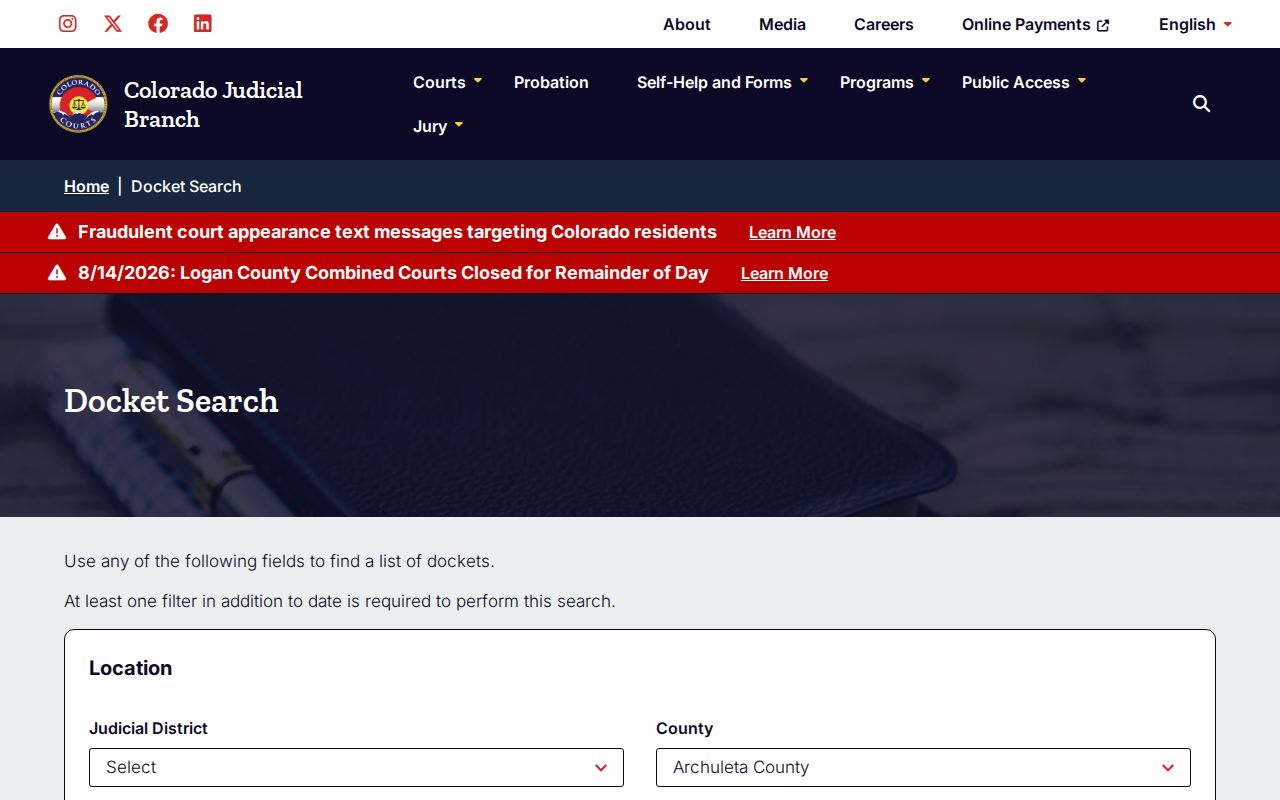
Here is the page's key limit in practice. The online result centers on scheduled events, while the clerk controls the fuller criminal case history and the documents behind it.
Stages on a Criminal Docket
A criminal Register of Action puts each court event in order. The public calendar may show only the hearing portions of that path. A complaint or filing opens the matter. Advisement follows in many cases. A charging paper states the offense and law. Arraignment records a plea and sets later steps. Pretrial and status events then manage motions, disclosure, negotiations, and trial readiness.
Docket flow: Filing › Advisement › Arraignment › Pretrial › Plea or Trial › Disposition › Sentencing
A motion hearing can end two ways. The judge may issue a minute order, or a signed order may follow. A plea or trial can resolve the allegations. Once that happens, sentencing adds its own entries covering the sentence and any conditions. Probation review shows up too. It often appears under the long local label "Return on Summons for Review of Probation." An appeal opens a fresh docket. For a District Court judgment, it usually lands in the Colorado Court of Appeals.
Archuleta County Criminal Docket Split
Where a charge lives depends on who filed it. Pagosa Springs Municipal Court keeps municipal charges. Archuleta County Court keeps state misdemeanors, and similar conduct can land in either system. So read the ticket, complaint, or notice first. Learn the charging authority before you search. Picking the wrong portal can return nothing even though a real case and setting exist. A municipal appeal can move into the state District Court path. That transfer still does not fold the original town docket into the Combined Courts calendar.
Reading Archuleta County Criminal Docket Labels
Colorado publishes no Archuleta-specific code key covering every criminal entry. The plain labels on your own ROA should control. Still, a few terms recur across the Archuleta County criminal docket and its calendar, so knowing them speeds up any docket search.
- Advisement
- An early appearance addressing rights, allegations, release, counsel, or the next procedure.
- Pretrial conference
- A setting for readiness, negotiation, disclosure, motions, and later scheduling.
- Disposition
- The recorded result of a charge or case, such as dismissal, acquittal, conviction, or another lawful outcome.
- Minute order
- A short court entry that records a ruling or courtroom event.
- Continuance
- A court-authorized move of a hearing to a new date.
Treat a warrant or failure-to-appear label with care. The public event row will not show the full basis or the current status. Ask the clerk or your counsel for the current court record, and never infer a result from an old setting alone.
Which Court Holds Criminal Dockets
The charging source and the offense level set the path. State felony cases belong to Archuleta County District Court. Misdemeanors go to Archuleta County Court. That court also takes state traffic offenses and some early felony work. Pagosa Springs Municipal Court keeps town ordinance cases on its own municipal docket. The municipal clerk, not the Combined Courts clerk, is the trial-level custodian for those city files. For state court records, the Archuleta County Justice Center sits at 109 Harman Park Drive in Pagosa Springs. The counter and the courthouse access terminal, when offered for the material you want, beat the web search. You can also reach the office at 970-264-8160 or archuletaclerk@judicial.state.co.us. Ask about file availability, an ROA, a charge paper, or a sentence order. Colorado Courts E-Filing is not a public criminal docket browser. It serves authorized filing and service roles. The Colorado Judicial Branch does name approved vendors for paid case-history data. But vendor data are not the official record and cannot supply filed-document copies.
Archuleta County Criminal Disposition Orders
Want the outcome, not just a court date? Use the clerk route. The Colorado Record/Document Request Form lets you ask for a Register of Action or a Disposition/Sentence Order. The ROA can summarize charges, sentences, and minute orders, while the separate order supplies the filed product. Submit a case number when you can, name the exact document, and ask whether certification is needed. The live form lists copies at $0.25 per page, with a $15 cap for parties and their attorneys but no page cap for nonparties. A certified or exemplified copy runs $20 per document. A name search costs $5. Off-site file retrieval costs the actual retrieval amount. Research or redaction is $30 per hour, billed in 15-minute parts after the first hour, so confirm the current total and payment steps before ordering. The online form is not the only door. You may ask at the Justice Center counter, call or email the clerk, or ask about courthouse terminal access. Archuleta does not publish specific mail, fax, or drop-box steps, so arrange any of those methods with the clerk before sending anything.
Public Access and Sealed Criminal Dockets
Chief Justice Directive 05-01 governs access to Colorado court records. It separates public information from excluded, restricted, or facility-only material. Juvenile cases may be confidential under Title 19. A suppressed or sealed matter may be omitted or masked in remote results. Protected identifiers can come out too. That can happen even when a public hearing or nonconfidential order stays open.
Key access rules: A failed name search does not prove that no criminal matter exists or that a record was sealed. Check the date, class, court, and municipal split, then ask the clerk about lawful access.
Chief Justice Directive 05-01 controls public and remote court-record access, restrictions, facility-only records, and correction procedures.
Colorado Title 19 supplies juvenile confidentiality rules that may limit public criminal docket information.
Someone with legal access to a restricted category may need government-issued photo identification. The clerk cannot hand over a sealed file just because a requester supplies a name. Keep the distinction clear: a court docket is a public reference to proceedings, while a certified disposition or sentence order is the official product for a formal need.
Virtual Archuleta County Criminal Docket Settings
Seeing “VIRTUAL” in an Appearance Type does not grant you permission to appear remotely. Archuleta Combined Courts does post courtroom links. Even so, the court is clear: a party needs prior approval before appearing online. A livestream lets you watch. It never substitutes for an appearance the court requires of you. Any mode listed on the Archuleta County criminal docket needs care. Read the newest notice or signed order before you rely on it. When doubt remains, ask the court to confirm.
Language help and self-help support are both available through the Colorado Judicial Branch. Its court interpreter program handles language access. Its self-help resources steer self-represented people toward forms and support without offering legal advice. A docket entry may show a probation-review setting. The Branch's probation information describes what that agency does. The setting itself still has to be confirmed with the court.
Continuances follow the same logic. Calling the clerk does not reset a date. Skipping the setting does not either. Only the judge can move a hearing, and only through a proper motion or request. Old event rows may linger as history even after a new date is set. So weigh three things together: the newest court notice, the latest public event, and word from the clerk. That check matters most when you are working from a printed or exported docket row.
Note: A courtroom link tells you what technology exists. The latest court order decides whether you may actually use it for a given hearing.